


INSEP Internship
6 months Engineering graduation internship
Date: February/August 2023
Where: In the INSEP's research laboratory
Main question:
How new generation shoes can impact
pro athletes race economy?

Context
For my final-year internship to validate my biomedical engineering degree at the ESEO engineering school, my primary objective was to apply the technical skills I had acquired throughout my studies while gaining valuable hands-on experience in a corporate environment.
During this internship, I had the opportunity to work on a real-world project, which allowed me to enhance my expertise in areas such as biomecanic, signal treatment, ect. This experience not only solidified my technical foundation but also exposed me to the dynamics of working in a team, project management, and navigating the challenges of the professional world.


Near-fields labs

International athletes

Youth academy

Big Installations

High Reputation
Where?
The INSEP (National Institute of Sport, Expertise, and Performance) is France's top training center for elite athletes.
It plays a crucial role in preparing athletes for international competitions through personalized coaching, world-class facilities, and cutting-edge sports science research.
INSEP provides comprehensive support, including medical, psychological, and technical assistance, ensuring athletes reach peak performance while benefiting from the latest advancements in sports science.


The SEP Laboratory
I worked within the SEP (Sport Expertise and Performance) laboratory, a research hub dedicated to advancing sports science.
The team consists of 13 researchers, 15 PhD students, and 3 engineers, all focused on three main areas: performance optimization, injury prevention, and athlete life balance.
This interdisciplinary team collaborates closely with INSEP and various sports federations, ensuring that their research directly supports the needs of elite athletes, from enhancing performance to promoting long-term health and well-being.


Assisting in the completion of a thesis in the world of running shoes


My goal was to contribute my biomedical engineering skills to assist a PhD student in successfully completing his thesis:
'How new generation shoes can impact pro athlete’s race economy?’
Focusing on shoes with incorporated carbon plates, a multifactorial analysis (live ultrasound, VO2, biomechanical analysis, etc.) will be conducted to identify which aspects are most affected by these new generation shoes.
Several tests will be conducted on a panel of around fifty high-level runners.


1st Test Range
Material used


VO2 mask
Data collected:
Gas exchange during exercise
Objectives:
Visualize data for each runner, with and without carbon-plated shoes
Tools used:
CSV file manipulation using Python
Optojump bands
Data collected:
Gas exchange during exercise
Objectives:
Filter all this data and add it to a database
Tools used:
CSV file manipulation using Python
Specified treadmill
-
Explanation of the tests to the patient
-
Setup of the sensors
-
15-minute warm-up for the runner to fully test the system
-
6 minutes at steady state with slight variations
-
A progressive increase until reaching maximal effort,
with increments every minute
Goal of the test
-
Physiological Profiling
-
Familiarization with the Runners
-
Establishment of Future Thresholds
-
Evaluate the possible impacts with and without new generation shoes on the runners' VO2 and stride to determine if there is a significant difference.

During the first test range, I conducted several visits and became proficient in handling various sensors and measurement systems used to collect biomechanical and physiological data from athletes.
My role involved filtering and processing the raw signals from these devices and organizing the data into a structured, visual, and easily accessible database.
The main objective was to transform complex datasets into clear, visual representations that could be effectively used for analysis and decision-making.
To achieve this, I developed and refined Python scripts to automate data cleaning, organization, and visualization, ensuring that the information was both accurate and actionable for performance optimization and injury prevention studies.
My part of the work


2nd Test Range
Goal of the tests
This visit was focused on a biomechanical analysis using a motion capture system, which allowed us to observe the impact of the shoes on athlete's posture and running technique.
This was combined with the collection of muscle and tendon data from the athletes, using ultrasound devices directly attached to them during the run.
My part of the work
I conducted some visits, handled the various sensors/systems.
Mainly on the ultrasound device.
I had to find a way to temporally synchronize all the data collected from different sensors, each having its own time reference


I was responsible for strategically placing the small grey markers on the athlete's body to ensure accurate motion capture data.
These markers reflect light back to the motion capture cameras, which track their movement in 3D space.


Using a medical ultrasound machine paired with a 13 MHz probe to avoid hindering the runner.
These markers reflect light back to the motion capture cameras, which track their movement in 3D space.


Real time view of the muscles during the test.

3rd Test Range
Goal of the test
The goal was to observe muscle response through a force/velocity profile immediately after using, or not using, carbon-plated shoes, and to assess the potential impact or lack thereof.
This analysis aimed to determine whether the use of carbon shoes directly influenced muscle performance and recovery in terms of power generation and speed, providing valuable insights into their effect on athletic performance.


1: The hamstring machine is used to assess the force-velocity profile of the athlete’s hamstring muscles
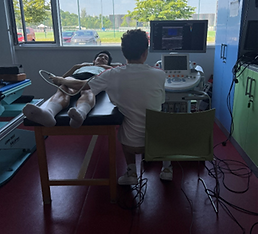
2: Pre-Visualization via Ultrasound and Data Collection Before the Test
3: Live Visualization of the Test and Data Collection and manipulation via Python Code
1
3
2
Test Procedure
My part of the work
I provided support during the ultrasound and the force/velocity profile test by assisting with the technical setup and ensuring accurate data collection.
Additionally, I conducted several visits to explain the procedures and findings to the athletes, ensuring they understood the process and its relevance.
I meticulously filtered the different signals obtained from the tests and organized the data into a comprehensive, visual, and user-friendly database to facilitate analysis and interpretation.